
In today’s digital-first world, businesses rely heavily on online strategies to attract customers, build brand awareness, and drive revenue. Two commonly used terms—digital marketing and performance marketing—often create confusion, especially for beginners. While they are closely connected, they serve different purposes and follow different approaches. Understanding the distinction between digital marketing and performance marketing is essential for students, marketers, and business owners who want to succeed in the competitive online landscape. This guide by Mohali School of Digital Marketing will break down both concepts in a simple and structured way, helping you understand how they work and when to use them effectively.
Digital marketing builds your presence, performance marketing drives your profits—MSDM teaches you to master both.
What is Digital Marketing?
Digital marketing is a broad concept that includes all types of marketing activities carried out through digital channels. It involves strategies such as search engine optimization (SEO), social media marketing, content marketing, email marketing, and more. The main goal of digital marketing is to create brand awareness, build trust, and engage with the target audience over time. It focuses on creating value for users by providing useful content, improving online visibility, and nurturing relationships. Unlike short-term tactics, digital marketing is often a long-term investment that helps businesses grow steadily and establish a strong online presence.
What is Performance Marketing?
Performance marketing is a specialized branch of digital marketing that focuses purely on measurable results. In this approach, advertisers pay only when a specific action is completed, such as a click, lead, or sale. This makes performance marketing highly efficient and result-oriented. This is commonly executed through paid advertising platforms, affiliate marketing, and sponsored campaigns. The biggest advantage of performance marketing is that every rupee spent is directly linked to a measurable outcome, making it easier to track return on investment (ROI) and optimize campaigns for better performance.
Key Differences Between Digital and Performance Marketing
Digital marketing is like building a foundation for your brand, while performance marketing is about driving immediate results.
- Goal: Digital marketing focuses on awareness; performance marketing focuses on conversions.
- Timeframe: Digital marketing is long-term; performance marketing delivers quicker results.
- Measurement: Performance marketing is highly measurable, while digital marketing may involve broader metrics like engagement and reach.
- Cost Structure: Digital marketing can include fixed costs, while performance marketing is often pay-for-results.
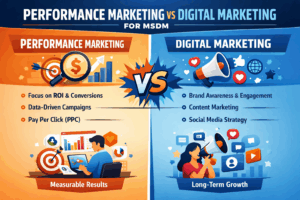
Digital marketing builds your brand, performance marketing drives results—together they create powerful growth. Both approaches are essential and work best when used together.
How Digital and Performance Marketing Work Together
It is important to understand that performance marketing is not separate from digital marketing—it is a part of it. The most effective marketing strategies combine both approaches. Digital marketing builds a strong foundation by increasing brand awareness and trust, while performance marketing focuses on driving immediate actions and conversions. For example, a business may use blog content and social media to educate its audience and then run paid ads to convert that audience into customers. This integrated approach ensures both short-term success and long-term growth.
Career Opportunities in Digital and Performance Marketing
The field of digital and performance marketing offers a wide range of career opportunities for students and professionals looking to build a future in the online space. Each role focuses on a different aspect of marketing, from building brand awareness to driving measurable results.
Digital Marketing Career Roles
In digital marketing, career opportunities are centered around creativity, strategy, and audience engagement. An SEO Specialist works on optimizing websites to rank higher on search engines by focusing on keyword research, backlink building, and technical improvements. A Content Marketer is responsible for creating blogs, articles, videos, and social media content that attracts and engages the target audience while building brand awareness.
A Social Media Manager handles platforms like Instagram, Facebook, and LinkedIn by planning content, running campaigns, and maintaining a consistent brand presence online. An Email Marketing Specialist focuses on designing email campaigns that nurture leads and retain existing customers through personalized communication. Overseeing all these roles is the Digital Marketing Manager, who is responsible for planning strategies, managing teams, and ensuring that all marketing efforts align with business goals.
Performance Marketing Career Roles
Performance marketing roles are more data-driven and focus on measurable outcomes like leads, sales, and return on investment. A Performance Marketer runs paid advertising campaigns on platforms such as Google Ads and Meta Ads, with a strong focus on conversions and ROI. A media buyer is responsible for purchasing ad placements across various platforms and optimizing budgets to achieve the best possible results.
A PPC (Pay-Per-Click) Specialist manages paid search campaigns, continuously analyzing metrics like cost per click (CPC) and cost per acquisition (CPA) to improve performance. An Affiliate Marketing Manager builds and manages partnerships with affiliates who promote products or services in exchange for commissions, helping drive sales efficiently. Lastly, a Conversion Rate Optimization (CRO) Specialist works on improving landing pages and marketing funnels to increase the percentage of visitors who take desired actions, such as making a purchase or filling out a form.
Together, these career paths offer diverse opportunities depending on whether you prefer creative storytelling or data-driven decision-making, making digital and performance marketing one of the most in-demand career choices today.
Both digital marketing and performance marketing offer exciting career opportunities. Digital marketing professionals need a wide range of skills, including SEO, content creation, social media management, and analytics. Performance marketers specialize in paid advertising, campaign optimization, and data analysis. As companies continue to invest in online marketing, the demand for skilled professionals in both fields is growing rapidly. Learning both areas can open doors to roles such as digital marketing manager, performance marketer, media buyer, and growth strategist.
Why You Need Both in Your Strategy
Relying only on one approach can limit your growth. Digital marketing helps you build trust and authority, while performance marketing ensures consistent leads and revenue.
For example, a strong social media presence builds credibility, and paid ads can convert that audience into customers. Combining both strategies creates a powerful marketing system that supports long-term success and short-term gains.
Top Performance and Digital Marketing Tips
To succeed in both digital and performance marketing, it is essential to follow a strategic and consistent approach. The first and most important step is to clearly understand your target audience. Knowing their needs, interests, and online behavior allows you to create content and advertisements that truly connect and drive engagement.
High-quality content plays a crucial role in building a strong digital presence. Whether it’s blogs, social media posts, or videos, valuable and engaging content helps attract and retain your audience while strengthening your brand identity. Alongside this, using data to make informed decisions is key, especially in performance marketing. Analytics tools provide insights into what is working and what needs improvement, allowing you to optimize campaigns for better results.
Search engine optimization is another important factor that cannot be ignored. By using relevant keywords, improving website speed, and creating valuable content, you can ensure your website reaches the right audience organically. At the same time, continuously testing and improving your campaigns is essential. Experimenting with different ad creatives, headlines, and targeting strategies can lead to significant improvements in performance.
Building a strong and consistent social media presence also helps in gaining trust and maintaining engagement with your audience. Platforms like Instagram, Facebook, and LinkedIn offer great opportunities to connect with users and grow your brand. Finally, tracking return on investment (ROI) and key performance indicators (KPIs) such as cost per lead, conversion rate, and return on ad spend ensures that your marketing efforts are effective and aligned with your business goals.
Role of MSDM in Building Your Career
MSDM focuses on providing practical knowledge and real-world experience in both digital marketing and performance marketing. The training programs are designed to help students understand industry trends, tools, and strategies that are currently in demand. By learning how to create and manage integrated marketing campaigns, students can become job-ready and confident in handling real business challenges. Whether you aim to work in a company, start your own business, or freelance, MSDM equips you with the skills needed for success.
Future Trends in Digital and Performance Marketing
The future of marketing is becoming increasingly data-driven and technology-focused. With the rise of artificial intelligence, automation, and advanced analytics, both digital marketing and performance marketing are evolving rapidly. Marketers now have access to tools that can predict customer behavior, personalize campaigns, and optimize performance in real time. Staying updated with these trends is essential for anyone who wants to remain competitive in the digital marketing industry.
Conclusion
Digital marketing and performance marketing are both essential components of a successful online strategy. While digital marketing focuses on building brand awareness and long-term relationships, performance marketing is designed to deliver immediate and measurable results. Instead of choosing one over the other, businesses should aim to combine both approaches for maximum impact. By understanding their differences and using them effectively, marketers can create powerful strategies that drive growth, engagement, and revenue. With the right training and guidance from Mohali School of Digital Marketing, you can master both and build a successful career in the digital world.