
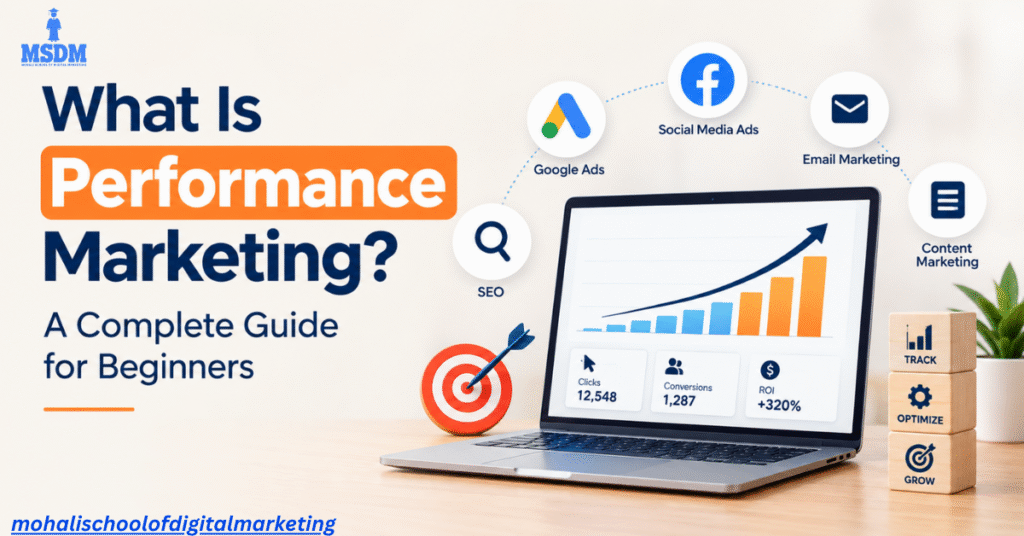
Performance marketing has become an important part of modern digital marketing because businesses want more than visibility—they want measurable results. Instead of focusing only on impressions, reach, or brand awareness, performance marketing focuses on specific actions such as clicks, leads, sales, registrations, app downloads, or enquiries. This approach allows marketers to understand how their campaigns are performing and make data-driven decisions to improve results.
For beginners, performance marketing may initially sound technical because it involves advertising platforms, analytics, conversion tracking, attribution, and different performance metrics. However, the basic idea is simple: businesses invest in marketing activities, track what users do, analyze the results, and continuously optimize campaigns to achieve their marketing objectives.
What Is Performance Marketing?
Performance marketing is a results-oriented approach to digital marketing where campaigns are planned and evaluated based on measurable actions. These actions can include generating a lead, completing a purchase, clicking an advertisement, signing up for a service, downloading an application, or submitting an enquiry. The exact action considered a successful result depends on the business objective.
For example, imagine an online clothing store spends ₹20,000 on an advertising campaign and generates ₹80,000 in trackable sales. The business can analyze the campaign to understand how much it spent, how many people clicked the advertisements, how many completed purchases, and how much revenue was generated. This measurable approach helps marketers understand the relationship between advertising activity and business outcomes.
How Does Performance Marketing Work?
The performance marketing process usually begins by defining a specific business objective. A company may want to generate leads, increase product sales, get more registrations, drive website enquiries, or increase app installations. Once the objective is clear, marketers select the appropriate marketing channel and create advertisements, landing pages, offers, and tracking systems around that objective.
After the campaign is launched, marketers collect performance data. This data can show how many people saw an advertisement, how many clicked it, how many completed the desired action, and how much the campaign cost. Conversion tracking is particularly important because it helps businesses connect advertising interactions with actions that matter to the business. Google Ads, for example, provides conversion tracking for actions such as purchases, leads, sign-ups, downloads, and phone calls. Google Ads Conversion Tracking
The next stage is optimization. Marketers analyze the campaign data and identify areas that can be improved. .
Why Is Performance Marketing Important?
Performance marketing is important because it gives businesses a structured way to measure their marketing activities. Instead of evaluating a campaign only by the number of people who saw an advertisement, marketers can look at actions such as leads, sales, conversions, and revenue.
Another important advantage is the ability to optimize campaigns using real-time or regularly updated performance data. Performance marketing can also help businesses understand where their marketing budget is being used. Metrics such as cost per lead, cost per acquisition, conversion rate, and return on ad spend can provide useful information about campaign efficiency. However, businesses should avoid relying on one metric alone because a low cost per lead, for example, does not necessarily mean that the leads are valuable.
Common Performance Marketing Pricing Models
Cost per click, commonly known as CPC, measures how much an advertiser pays for each click. It can be calculated by dividing total advertising expenditure by the number of clicks. CPC can be useful when evaluating traffic-focused campaigns, but marketers should also examine whether those clicks lead to meaningful actions.
Cost per lead, or CPL, measures the average amount spent to generate a lead. For example, if a business spends ₹10,000 on advertising and receives 100 leads, the CPL is ₹100. However, businesses should also evaluate lead quality because a low-cost lead is not necessarily a valuable lead.
Cost per acquisition, or CPA, measures the average cost associated with generating a defined conversion or acquisition. Google Ads provides CPA-related reporting to help advertisers understand conversion costs. Google Ads Conversion Metric
Important Performance Marketing Metrics
Performance marketers use several metrics to understand campaign results. Click-through rate, or CTR, measures the percentage of people who click an advertisement after seeing it. Conversion rate measures the percentage of relevant users who complete a desired action. Cost per lead shows the average advertising cost required to generate a lead, while cost per acquisition measures the cost associated with a defined conversion.
Customer acquisition cost, or CAC, provides a broader view of the cost involved in acquiring customers and can include expenses beyond advertising. Customer lifetime value, commonly called LTV, estimates the value a customer may generate over the course of their relationship with a business. Looking at acquisition cost together with customer value can provide a more meaningful understanding of marketing performance.
Performance Marketing and Conversion Tracking
Conversion tracking is one of the most important parts of performance marketing. Without reliable tracking, marketers may know how many people clicked an advertisement but may not know how many users eventually completed the desired action.
Businesses can track actions such as purchases, lead form submissions, registrations, phone calls, downloads, and other important events. Google Analytics can also help marketers understand how users interact with websites and how different marketing touchpoints contribute to conversions.: Google Analytics
Proper tracking allows marketers to move beyond surface-level metrics and understand what is actually contributing to business outcomes. Tracking should therefore be planned before a campaign is launched rather than added as an afterthought.
What Is Attribution in Performance Marketing?
Customers rarely follow a single path before making a purchase. A person may first discover a brand through social media, later search for the brand on Google, visit the website, receive an email, and finally make a purchase. Attribution is used to understand how credit for a conversion is assigned across these different interactions.
Google Analytics provides different attribution approaches that help marketers analyze customer journeys and conversion touchpoints. : Google Analytics Attribution Understanding attribution is important because relying on only one touchpoint can provide an incomplete picture of how customers discovered and interacted with a business.
Performance Marketing vs Digital Marketing
Performance marketing and digital marketing are closely related, but they are not exactly the same. Digital marketing is a broad term that includes activities such as SEO, content marketing, social media marketing, email marketing, paid advertising, influencer marketing, and other digital channels. Performance marketing is more specifically focused on measurable outcomes and campaign optimization. For example, SEO may focus on improving organic visibility and long-term website traffic, while a performance marketing campaign may focus on generating a specific number of leads or sales within a defined budget. This does not mean that one approach should replace the other. Businesses can use different digital marketing activities together depending on their goals. For example, SEO and content marketing can help build long-term organic visibility, while paid performance campaigns can provide immediate opportunities to reach targeted audiences.
How to Create a Performance Marketing Strategy
- Creating a performance marketing strategy starts with defining a clear business objective, such as generating leads, increasing sales, or driving enquiries. This goal helps marketers choose the right channel, audience, advertisement, landing page, and performance metrics.
- The next step is understanding the target audience. Marketers should identify their customers’ needs, interests, problems, and preferred digital platforms to create more relevant campaigns.
- After that, marketers can choose suitable channels such as search advertising, social media advertising, email marketing, or affiliate marketing based on their goals and audience.
- The campaign should include a clear advertisement, relevant offer, and user-friendly landing page that encourages visitors to take action.
- Finally, conversion tracking should be set up before launch. Once data is collected, marketers can analyze results and test different ads, audiences, keywords, landing pages, and calls to action to improve performance.
Common Performance Marketing Mistakes Beginners Make

- One common mistake beginners make is focusing too much on clicks. Clicks are useful, but they do not automatically represent business success. A campaign can generate many clicks but very few sales or qualified leads. Therefore, marketers should connect traffic metrics with conversion and business data.
- Another common mistake is launching campaigns without proper conversion tracking. If conversions are not tracked correctly, marketers may struggle to determine which campaigns or advertisements are generating valuable results.
- Beginners may also make the mistake of narrowing their audience too much. Highly restrictive targeting can reduce the number of people who can see an advertisement and may limit the campaign’s ability to collect useful data. Audience targeting should be relevant but should also provide enough room for the advertising platform to optimize delivery.
- Ignoring the landing page is another common problem. An advertisement can attract the right audience, but if the landing page is confusing, slow, irrelevant, or difficult to navigate, users may leave without converting.
- Finally, marketers should avoid making major decisions based on very limited data. Performance can change because of audience behaviour , competition, seasonality, budget, creative fatigue, and other factors. Campaign optimization should therefore be based on meaningful data and clear objectives.
Tools Used in Performance Marketing
Performance marketers commonly work with advertising platforms, analytics systems, tracking tools, and CRM platforms. Google Ads and Meta Ads are widely used for paid advertising, while Google Analytics can help businesses analyze website and user behaviour data. Google Tag Manager can be used to manage tags and tracking implementations.
CRM systems can also play an important role because generating a lead is not always the final business objective. A business may need to track whether a lead was contacted, qualified, converted into a customer, or eventually generated revenue. Connecting marketing data with customer data can therefore provide a more complete understanding of campaign performance.
Is Performance Marketing Suitable for Small Businesses?
Performance marketing can be useful for small businesses because digital campaigns can be launched with controlled budgets and measured through specific actions. A local business may use performance campaigns to generate phone calls, website enquiries, lead forms, or store-related enquiries.
For an e-commerce business, the focus may instead be on product purchases, revenue, customer acquisition cost, and ROAS. The right approach depends on the business model and customer journey. A small business should therefore define its objective and economics before selecting campaign channels and budgets.
Skills Required for a Performance Marketing Career
People interested in building a career in performance marketing can benefit from developing several skills. Paid advertising is important because marketers need to understand how advertising platforms work, including targeting, bidding, campaign objectives, creatives, and reporting.
Analytics is another essential skill. Performance marketers need to understand metrics, conversion tracking, attribution, and campaign reports. Copywriting and creative thinking are also useful because advertisements need to communicate value and encourage users to take action.
Landing page optimization, basic technical tracking knowledge, data analysis, and testing are also valuable. Most importantly, marketers should understand how marketing activity connects with business outcomes such as revenue, customer acquisition, and customer retention.
How Beginners Can Start Learning Performance Marketing
Beginners should start by learning the fundamentals of digital marketing before trying to master multiple advertising platforms at once. Understanding concepts such as customer journeys, target audiences, conversion funnels, SEO, social media marketing, content marketing, and paid advertising provides a strong foundation.
After learning the fundamentals, beginners can choose one advertising platform and learn how campaigns, targeting, budgets, creatives, bidding, and conversions work. Google Ads and Meta Ads are two useful areas to study because they expose learners to different approaches to paid digital advertising.
The next step is learning analytics and conversion tracking. Beginners should understand how users move from an advertisement to a website and eventually complete a desired action. Practical exercises, campaign simulations, case studies, and real projects can help turn theoretical knowledge into practical skills.
The Future of Performance Marketing
Performance marketing is becoming increasingly connected with automation, artificial intelligence, analytics, and machine-learning-powered advertising systems. Advertising platforms can automate parts of bidding, targeting, creative testing, and campaign optimization, which means marketers increasingly need to understand how to interpret data and make strategic decisions.
However, technology does not eliminate the importance of marketing fundamentals. Understanding customers, creating relevant offers, writing effective advertising copy, building useful landing pages, measuring conversions, and interpreting business data remain important skills.
The future of performance marketing is therefore likely to involve a combination of human strategy, creative thinking, data analysis, automation, and AI-powered tools. Marketers who understand both the fundamentals and the technology behind modern advertising can better adapt as digital platforms continue to change.
Frequently Asked Questions
1. What is performance marketing?
Performance marketing is a results-driven approach to digital marketing that focuses on measurable actions such as leads, sales, clicks, registrations, and conversions.
2. What are the main channels of performance marketing?
The main channels include Google Ads, social media advertising, affiliate marketing, email marketing, display advertising, influencer marketing, and retargeting.
3. What are the most important performance marketing metrics?
Common metrics include CTR, conversion rate, CPC, CPL, CPA, ROAS, customer acquisition cost, and customer lifetime value.
4. Do beginners need coding skills to learn performance marketing?
No, advanced coding skills are not required to get started. However, learning basic concepts of analytics, conversion tracking, tags, and website data can be helpful.
5. How can I start a career in performance marketing?
Start by learning digital marketing fundamentals, followed by Google Ads, Meta Ads, analytics, conversion tracking, and campaign optimization. Practical projects and hands-on experience can help build job-ready skills.
Final Thoughts
At Mohali School of Digital Marketing (MSDM), we believe performance marketing is not just about running advertisements—it is about understanding the complete journey from reaching the right audience to generating measurable business results. As digital advertising continues to evolve, marketers need to understand search advertising, social media campaigns, analytics, conversion tracking, and campaign optimization to make informed marketing decisions.For beginners, building these skills step by step can create a strong foundation for a career in digital marketing. Learning the fundamentals, working with real-world tools, analyzing campaign data, and gaining practical experience can help learners understand how performance marketing works beyond theory.