
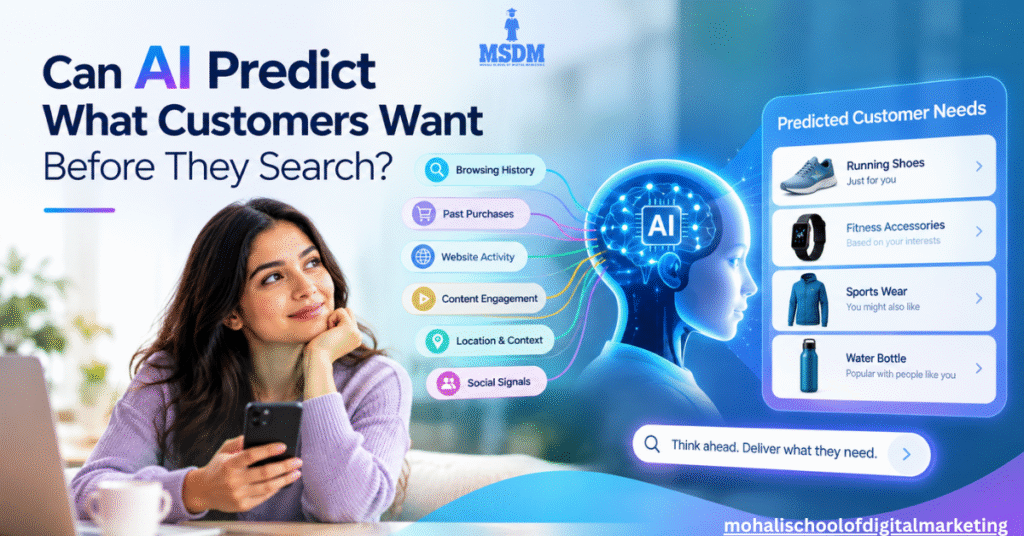
Imagine opening your phone and seeing a product recommendation that feels almost perfectly timed. You were not actively searching for it, but somehow the brand understood what you might need. This is where Artificial Intelligence (AI) and predictive marketing are changing the way businesses understand customers.AI can analyze large amounts of customer data, identify patterns, understand behavior, and predict what a customer may be interested in next. It cannot literally read someone’s mind, but it can use signals from past behavior and current activity to make increasingly relevant predictions .
For marketers, this raises an interesting question: Can AI predict what customers want before they search for it?
The answer is becoming increasingly yes—but with an important condition: the quality, relevance, and responsible use of customer data matter just as much as the AI itself.
What Is Predictive Marketing?
Predictive marketing is the use of data, artificial intelligence, machine learning, and analytics to anticipate future customer behavior . Instead of waiting for a customer to search for a product, click an advertisement, or make a purchase, businesses can analyze previous signals to estimate what the customer may do next.
For example, imagine a customer who:
- Searches for running shoes
- Watches fitness-related videos
- Reads articles about marathon training
- Visits several sports websites
- Compares different shoe models
- Adds a pair of shoes to a wish list
Individually, these actions may not reveal much. But when AI analyzes them together, they can create a behavioral pattern suggesting that the customer may soon be interested in buying running shoes.
This is the basic idea behind predictive marketing.
How Does AI Predict Customer Intent?
AI does not predict customer needs through guesswork. It looks for signals and patterns in data.
1. AI Studies Past Behavior
One of the strongest signals is what customers have done previously.
AI can analyze:
- Previous purchases
- Website visits
- Search behavior
- Products viewed
- Email interactions
- Advertisement clicks
- App activity
- Content engagement
- Shopping history
For example, if someone regularly purchases skincare products every few months, an AI system may identify a recurring pattern and predict when that customer could be interested in purchasing again.
2. AI Identifies Patterns
A single action rarely tells the complete story.
For example, visiting a product page does not necessarily mean someone wants to buy the product.
However, if a customer:
Views → Compares → Reads reviews → Returns to the product → Adds to cart
the combined signals can indicate stronger purchase intent.
AI can analyze these patterns much faster than a human marketing team manually reviewing thousands of customer journeys.
3. AI Uses Real-Time Signals
Customer intent can change quickly. Someone who searched for a laptop last month may have completely different needs today.
AI systems can therefore use more recent signals such as:
- Current searches
- Recent website activity
- Location-related information where appropriately permitted
- Product interactions
- Current campaigns
- Seasonal behavior
- Recent purchases
This allows marketers to move from simply understanding what customers did to estimating what they may want next.
Can AI Really Know What a Customer Wants?
Not exactly .This distinction is important.
AI does not know a customer’s thoughts or guarantee what they will purchase. Instead, it identifies patterns that indicate probable intent.
For example:
A customer searches for “best budget smartphones,” watches smartphone comparison videos, and visits several product pages.
AI may predict that the customer is researching smartphones and could be closer to a purchase. But the customer might simply be researching for a friend. Therefore, AI predictions should be treated as probabilities rather than facts .This is one reason human judgment remains important in AI-powered marketing.
How Businesses Can Use AI to Anticipate Customer Needs
AI-powered prediction can be applied across different stages of the customer journey.
Personalized Product Recommendations
E-commerce websites can recommend products based on browsing and purchasing behavior.
For example:
Customer buys a camera → AI recommends a memory card, camera bag, or tripod.
The recommendation is based on the relationship between products and the customer’s behavior.
Predictive Email Marketing
Instead of sending the same email to everyone, AI can make email marketing more personalized by helping marketers determine:
- What content a customer may find relevant
- When they may be more likely to engage
- Which products could interest them
- Which customers may need a reminder
This can make email communication more relevant instead of simply increasing the number of messages sent.
Predictive Advertising
AI can analyze customer signals to help advertising platforms identify audiences that may be more likely to take a particular action.
For example, a brand selling fitness equipment may use behavioral signals to identify people who appear interested in fitness-related products or content.The goal is not simply to reach more people but to make advertising more relevant to potential customers.
Customer Retention
AI can also be used to identify customers who may be at risk of leaving.
For example, a subscription business might notice that a customer:
- Has stopped using the service
- Has reduced engagement
- Has not opened recent communication
- Has contacted customer support several times
A predictive system could identify this pattern and alert the marketing or customer-success team.
McKinsey describes this broader approach as a “next best experience,” where AI can help businesses determine appropriate customer interactions based on signals across the customer journey.
The Role of Data in Predictive Marketing
AI is only as useful as the information it can work with .If customer data is incomplete, outdated, duplicated, or disconnected between systems, AI predictions can become less reliable. This is becoming an important issue for marketers. According to Salesforce’s 2026 State of Marketing research, 75% of marketers globally have adopted AI, while data silos and poor data quality remain major barriers to AI-powered personalization .The situation is also significant in India. Salesforce reported in 2026 that 81% of marketers in India had adopted AI, while many continued to face challenges related to disconnected or irrelevant customer data.
This shows an important lesson:
AI alone does not create personalization. Useful data + AI + good marketing strategy create personalization.
AI Is Changing Search Behavior Too
Customer prediction is not limited to advertising and e-commerce. The way people search for information is changing.
Traditional search often looks like: Keyword → Search results → Website → Decision
AI-powered search increasingly supports: Question → Context → Conversation → Recommendation → Decision
Google has continued expanding AI features in Search, including AI Mode and AI Overviews. Google says AI Mode is designed to understand more complex questions and support conversational follow-up searches .This means marketers need to think beyond individual keywords.
They increasingly need to understand:
- What questions customers ask
- What problems they are trying to solve
- What information they need before purchasing
- What related questions they may ask next
- How AI systems may interpret and present their content
This is one reason SEO and Answer Engine Optimization (AEO) are becoming increasingly connected.
From Search Intent to Predictive Intent
Traditional SEO focuses heavily on search intent.
For example:
“Best digital marketing course in India”
tells a marketer that the person is researching digital marketing courses.
Predictive marketing goes one step further. It asks :What might this person need next?
Perhaps the customer may want to know:
- Course fees
- Course duration
- Certifications
- Placement opportunities
- Practical projects
- Career options
AI can help marketers understand these connected stages of the customer journey.
The future of marketing may therefore move from simply answering what customers search for to anticipating what information they may need next.
Examples of AI Predicting Customer Needs
Example 1: E-Commerce
A customer frequently purchases running clothes.
AI identifies the pattern and notices that the customer has recently started browsing running shoes.
The system may recommend :Running shoes + sports socks + fitness accessories
before the customer specifically searches for those products.
Example 2: Travel
A customer frequently searches for weekend destinations and hotel deals. AI may identify travel-related intent and personalize content around:
- Weekend trips
- Hotels
- Transportation
- Travel packages
- Local experiences
The prediction comes from a combination of behavioral signals rather than one search.
Example 3: Digital Marketing Education
Suppose someone repeatedly reads articles about:
- SEO
- Google Ads
- Meta Ads
- Content marketing
- AI marketing
AI could identify an increasing interest in digital marketing as a topic. A training institute could then provide relevant educational content, such as a guide to digital marketing careers or practical SEO learning .This is where predictive marketing can connect content marketing, personalization, and lead generation.
Benefits of Predictive AI in Marketing
Better Personalization
AI can help brands provide more relevant content, products, and recommendations.
Improved Customer Experience
Customers may spend less time searching for information because relevant options are presented earlier.
More Efficient Marketing
Instead of treating every customer identically, marketers can focus communication according to behavioral signals.
Better Timing
Predictive systems can help identify when a customer may be more receptive to a particular message.
Stronger Customer Relationships
When personalization is useful rather than intrusive, customers can receive experiences that feel more relevant to their needs.
McKinsey notes that AI and generative AI can help businesses scale personalized experiences across large and diverse customer groups.
The Biggest Challenge: Personalization vs Privacy
There is an important line between helpful personalization and uncomfortable tracking. Imagine searching for a product once and seeing advertisements for that exact product everywhere for the next two weeks .Instead of feeling helpful, it may feel intrusive.
That is why marketers need to consider:
- Transparency
- Consent
- Data security
- Data quality
- Frequency of communication
- Relevance
- Customer expectations
Personalization should answer the question:
“How can we make this customer’s experience more useful?” rather than:
“How much data can we collect about this customer?”
Responsible data practices are therefore an essential part of AI marketing.
Will AI Replace Human Marketers?
Predictive AI can process enormous amounts of data and identify patterns quickly, but marketing is not only about prediction.
Marketing also requires:
- Creativity
- Storytelling
- Emotional understanding
- Brand strategy
- Cultural awareness
- Ethical judgment
- Strategic decision-making
AI can tell a marketer that a customer segment is showing increased interest in a product .A human marketer still needs to decide what the brand should say, how it should say it, and whether the recommendation makes sense. The most effective approach is therefore likely to be collaboration between AI and human marketers rather than treating them as replacements for one another.
What Does the Future of Predictive Marketing Look Like?
The future may move from reactive marketing to proactive marketing.
Traditional marketing often waits for a customer signal: Customer searches → Brand responds
Predictive marketing attempts to identify signals earlier: Customer behavior → AI identifies pattern → Brand prepares relevant experience
As AI systems become more capable, marketers may increasingly use them to coordinate personalized experiences across websites, advertisements, email, search, social media, and customer service. McKinsey’s 2026 research describes a marketing environment increasingly shaped by AI-driven personalization, real-time decision-making, and agentic systems that can act across workflows. However, prediction will not eliminate uncertainty. Customers remain unpredictable, preferences change, and not every behavioral pattern leads to a purchase. The goal is therefore not to predict customers perfectly. The goal is to understand them better and respond more intelligently.
Frequently Asked Questions
1. Can AI really predict customer behavior?
AI cannot know exactly what a customer will do. It analyzes historical and real-time behavioral signals to estimate possible future actions.
2. What is predictive marketing?
Predictive marketing uses AI, machine learning, analytics, and customer data to identify patterns and anticipate potential customer behavior.
3. How does AI understand customer intent?
AI can analyze signals such as searches, website activity, purchases, content engagement, and other permitted customer interactions to identify patterns associated with different types of intent.
4. Can AI predict what customers will buy?
AI can estimate which products or services a customer may be interested in based on behavioral patterns. However, these predictions are probabilities, not guarantees.
5. Is predictive marketing useful for small businesses?
Yes. Small businesses can use predictive approaches through tools such as analytics, CRM platforms, recommendation systems, email automation, and advertising platforms, depending on their data and resources.
6. Will predictive AI replace digital marketers?
Predictive AI can automate analysis and assist with decision-making, but human marketers remain important for creativity, strategy, communication, brand building, and ethical decisions.
Conclusion
Predictive marketing is changing the way businesses understand and connect with their customers. With AI, customer data, and real-time insights, brands can identify patterns, anticipate potential needs, and deliver more relevant experiences at the right time. However, the future of marketing is not about replacing human marketers with AI. It is about combining AI-powered insights with human creativity, strategy, and understanding. Businesses that learn to use data responsibly and apply AI effectively can build stronger customer relationships and create more personalized marketing experiences. At Mohali School of Digital Marketing (MSDM), we believe that staying updated with emerging technologies is an essential part of becoming a successful digital marketer. Learning how AI, predictive analytics, SEO, advertising, and automation work together can help marketers prepare for the rapidly evolving digital landscape.
The future of marketing is not just about predicting what customers want—it is about understanding them better and creating experiences that genuinely add value.