
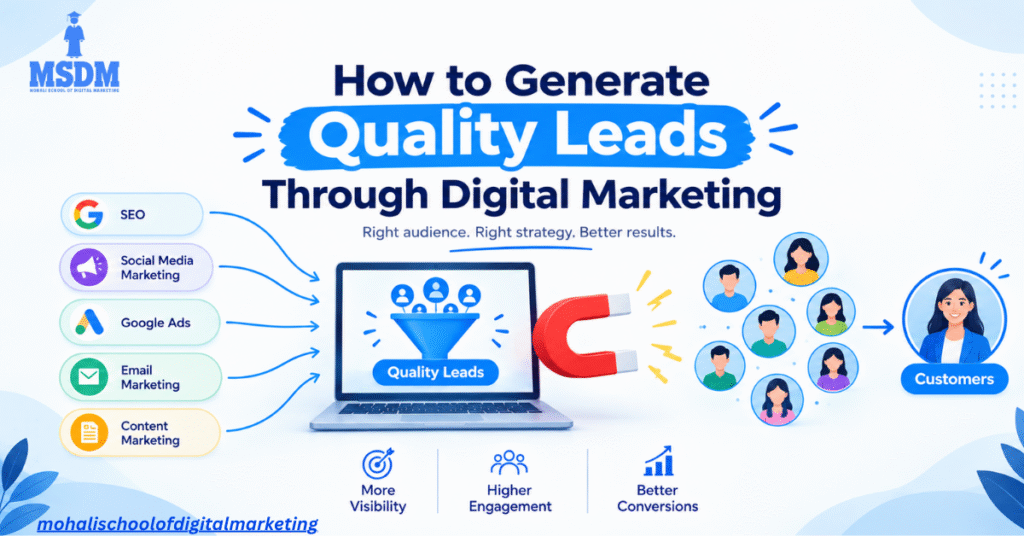
Getting a large number of leads sounds good, but numbers alone do not guarantee business growth. A company may receive hundreds of enquiries and still struggle to make sales if those enquiries are not relevant. This is why businesses are increasingly focusing on quality lead generation rather than simply collecting more leads. Digital marketing provides multiple ways to reach people who are more likely to be interested in a product or service.
What Is a Quality Lead?
A quality lead is a potential customer who has a genuine interest in what a business offers and has a reasonable possibility of becoming a customer. In digital marketing, quality leads are often identified through actions that show real buying intent. For example, someone who downloads a random free resource may not be as valuable as someone who requests a quotation, books an appointment, or asks about pricing. The definition of a quality lead can be different for every business. A coaching institute may consider a student who enquires about admission a quality lead, while a real-estate company may consider someone requesting property details more valuable. Therefore, businesses should first understand what a valuable lead looks like for them and then use the right digital marketing strategies to attract and convert those potential customers.
Start With the Right Audience
One of the first steps to generate quality leads through digital marketing is understanding the target audience. Businesses should know who their potential customers are, what problems they face, what they search for online, and what influences their buying decisions. Instead of trying to reach everyone, marketers can create campaigns and content around specific customer needs. A clear audience helps businesses create more relevant advertisements, website content, social media posts, and offers.
Use SEO to Attract People With Search Intent
SEO can help businesses reach people who are actively searching for information, products, or services. By creating useful pages around relevant topics and search queries, a website can attract visitors who already have an interest in a particular problem or solution. For example, a digital marketing institute can create content around “digital marketing courses,” “SEO training,” or “Google Ads courses.” The goal should not simply be to include keywords, but to provide useful information that matches what the searcher actually wants. Google provides guidance on creating search-friendly websites and monitoring search performance through Search Console.
Use Paid Ads With a Clear Objective
Paid advertising can help businesses reach a targeted audience more quickly. Platforms such as Google Ads allow marketers to create campaigns around specific goals, including lead generation. However, getting clicks should not be the only objective. Businesses should decide what action they want users to take, such as submitting a form, calling the business, requesting a quote, or booking an appointment. Google recommends aligning advertising campaigns with meaningful conversion goals and tracking the lead journey beyond the initial interaction.
Create Landing Pages That Convert
A person may click an advertisement because the message looks interesting, but the landing page determines what happens next. If the page is confusing, slow, difficult to navigate, or unrelated to the advertisement, the visitor may leave without taking action. A good landing page should communicate the main benefit quickly, explain the offer clearly, build trust, and provide an easy next step. The advertisement and landing page should also have a consistent message so that visitors know they have reached the right place.
Create Content That Solves Problems

Content marketing can help businesses attract potential customers before they are ready to make a purchase. Blog posts, guides, videos, social media content, FAQs, and case studies can answer questions and build familiarity with a brand. Instead of constantly promoting a product, businesses can create content around the problems their audience is trying to solve. When useful content attracts the right audience, it can become an important part of the lead-generation journey.
Use Social Media Strategically
Social media can support lead generation by helping businesses build awareness, demonstrate expertise, and interact with potential customers. A strong social media strategy can include educational posts, short videos, customer questions, product demonstrations, testimonials, and clear calls to action. The objective should not always be to make every post promotional. Providing useful information and encouraging meaningful interaction can help move people from awareness toward consideration.
Track More Than Lead Volume
A common mistake is measuring a campaign only by the number of leads generated. A campaign might produce many leads but very few actual customers. Businesses should therefore track what happens after a lead enters the system. Metrics such as conversion rate, cost per lead, qualified leads, cost per acquisition, and sales generated can provide a clearer picture of campaign performance. Google Ads supports tracking valuable actions such as purchases, sign-ups, and phone calls, allowing businesses to connect advertising activity with meaningful customer actions.
Follow Up With Leads Quickly
Digital marketing does not end when someone submits a form. Follow-up can have a major role in turning an enquiry into a customer. Businesses should have a clear process for responding to enquiries, answering questions, sharing relevant information, and moving qualified prospects toward the next step. A lead-generation campaign works best when marketing and sales processes are connected. Google Ads also provides ways to distinguish between qualified leads and converted leads, helping businesses measure deeper stages of the customer journey instead of focusing only on initial lead volume.
Test, Learn, and Improve
There is rarely one perfect digital marketing campaign. Audience preferences, competition, offers, creative formats, and search behavior can change. This is why marketers should regularly test different headlines, ad creatives, landing pages, calls to action, and audience segments. The data from these tests can reveal what attracts the right audience and where potential customers drop out. Over time, these insights can help businesses improve both lead quality and marketing efficiency.
Final Thoughts
To generate quality leads through digital marketing, businesses need more than attractive advertisements or high website traffic. The process starts with understanding the right audience and continues through relevant content, SEO, targeted advertising, strong landing pages, clear offers, conversion tracking, and effective follow-up.
At Mohali School of Digital Marketing (MSDM), students can learn how these different digital marketing channels work together to support real business objectives. Understanding how to attract, qualify, track, and nurture leads can help marketers move beyond simply generating traffic and focus on creating meaningful business opportunities.
FAQs
1. What is quality lead generation?
Quality lead generation means attracting potential customers who have genuine interest in a business’s product or service and are more likely to convert.
2. How can SEO generate quality leads?
SEO can attract people searching for relevant products, services, or solutions. Useful content and optimized pages can connect businesses with users who have relevant search intent.
3. Can paid ads generate quality leads?
Yes. Paid ads can reach selected audiences and searchers, but campaigns should use relevant targeting, clear offers, and meaningful conversion goals.
4. Why are landing pages important for lead generation?
Landing pages provide the next step after an advertisement or other marketing interaction. A clear and relevant landing page can make it easier for visitors to understand the offer and take action.
5. Which metrics should businesses track?
Businesses can track metrics such as conversion rate, cost per lead, qualified leads, cost per acquisition, and sales generated instead of focusing only on total lead volume.