
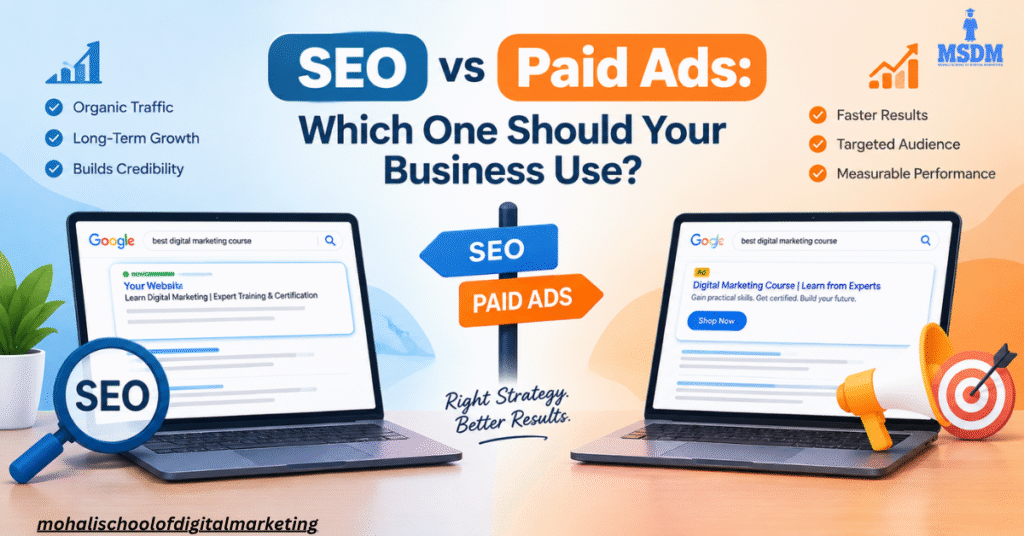
Imagine that someone searches Google for a product or service your business offers. Your website could appear in front of that person in two very different ways. It might appear naturally in the search results because your website has strong SEO, or it might appear as an advertisement because you are paying for that visibility. Both methods can bring visitors to your website, but the way they work, the time they require, and the type of results they can support are different. This is where the question of SEO vs Paid Ads becomes important for businesses planning their digital marketing strategy.
SEO and Paid Ads Start With the Same Goal
Although SEO and paid advertising use different methods, they often have the same basic objective: getting the right people to discover a business online. SEO, or Search Engine Optimization, focuses on improving a website so that search engines can understand its content and show it for relevant searches. Paid advertising, on the other hand, allows businesses to pay for advertising space and target potential customers according to selected keywords, audiences, locations, interests, or other campaign settings.
The difference becomes clearer when we think about what happens after the campaign or optimization work begins. SEO is like building a digital asset that can continue attracting organic visitors over time. Paid advertising is more like renting visibility for a specific period. Both can be useful, but they solve different marketing problems.
What Makes SEO Different?
SEO is not simply about adding keywords to a webpage. Modern SEO involves creating useful content, improving website structure, making pages accessible to search engines, developing relevant internal links, earning quality backlinks, improving page experience, and understanding what users actually want when they search.
For example, suppose a digital marketing institute wants to attract students searching for digital marketing courses. Instead of only creating an advertisement, the institute could publish helpful content about SEO courses, Google Ads, social media marketing, career opportunities, and digital marketing skills. Over time, these pages can help the website become more visible for relevant searches.
The important point is that SEO usually requires patience. A business cannot publish one article today and expect it to dominate search results tomorrow. Search visibility develops through consistent content, technical improvements, relevance, and overall website quality.
What Makes Paid Ads Different?
Paid advertising takes a more direct route. Instead of waiting for a webpage to gain organic visibility, a business can create an advertising campaign and pay a platform to show its advertisement to selected audiences.
For example, an online clothing store launching a festive collection may not want to wait months for organic visibility. It could create paid campaigns designed to reach potential customers interested in its products. Similarly, a local service provider could use search advertising to reach people who are actively searching for a particular service.
The major advantage of paid advertising is control. Businesses can decide how much they want to spend, which audience they want to target, what message they want to show, and where they want to send users. However, the traffic is connected to the campaign. When advertising stops, the paid visibility generally stops as well.
SEO vs Paid Ads: Which One Is Faster?
If the main objective is speed, paid advertising can provide visibility much faster than SEO. After a campaign is created, approved, and launched, advertisements can begin reaching the selected audience. SEO works differently. Search engines need time to discover, understand, evaluate, and rank webpages. The timeline can vary significantly depending on the website, competition, content, search demand, and many other factors.
This does not mean that paid ads are automatically better. It simply means that the two strategies operate on different timelines. A business running a weekend sale may need immediate visibility, while a business building a long-term information resource may be more interested in organic search growth.
Which One Costs More?
There is no universal answer to whether SEO or paid advertising is cheaper because the costs depend on the business and the strategy.
SEO can involve spending on content writers, SEO specialists, technical improvements, website development, tools, and content promotion. Even when a business handles SEO internally, there is still a time investment involved.
Paid advertising has a more direct spending model. Businesses set advertising budgets and pay according to the platform’s pricing system. Costs can change based on factors such as competition, keywords, audience, location, industry, and campaign quality.
Therefore, businesses should look beyond simply asking, “Which one is cheaper?” A more useful question is: Which strategy can support the specific business objective within the available resources?
The Visibility Difference
Another interesting difference between SEO and paid ads is how users may interact with them. Paid results are clearly identified as advertisements, while organic results appear naturally within search results.
A user searching for “best digital marketing course” might see advertisements first and organic results below them. Both can attract attention, but users may interact with them differently depending on their search intent and trust in advertising versus organic results.
This is why businesses should not look at visibility as a simple competition between paid and organic results. Instead, they can consider how both types of visibility contribute to the customer’s search journey.
What About Long-Term Results?
One of the strongest reasons businesses invest in SEO is its potential to build long-term organic visibility. A useful webpage can continue attracting visitors from search engines after it has been published, provided that it remains relevant and competitive.
Paid ads work on a different model. A campaign can generate traffic while it is active, but that traffic is directly connected to advertising spend. Once the campaign ends, the paid exposure normally ends with it. This makes SEO particularly relevant for businesses that want to build a long-term content and search presence. Paid advertising can complement that effort by supporting short-term campaigns, launches, promotions, and targeted customer acquisition.
What Should a New Business Do?
A new business often faces a difficult choice because it needs visibility but may have a limited budget. Instead of treating SEO and paid advertising as completely separate choices, the business can consider what it needs at each stage.
Paid advertising can help a new business test its offers, understand which messages attract attention, and generate initial traffic. At the same time, SEO can be developed gradually through useful website pages, keyword-focused content, technical improvements, and relevant internal linking.
This approach allows a business to work on immediate visibility while also building a foundation for future organic traffic.
Can SEO Data Help Paid Ads?
Interestingly, the relationship works both ways. SEO and paid advertising can provide useful information for each other .For example, paid campaigns can reveal which search terms receive attention and which messages generate engagement. Those insights can help businesses think about future content. Similarly, SEO research can reveal the questions and topics people are searching for, which can help businesses develop more relevant advertising messages.
Instead of treating SEO and paid ads as two completely isolated departments, businesses can use insights from both to understand their audience better.
SEO vs Paid Ads: What Should Your Business Use?
There is no single strategy that fits every business. A business with a long sales cycle and customers who spend time researching before purchasing may benefit from building a strong organic content presence. A business promoting a limited-time offer may need the speed and targeting capabilities of paid advertising.
The decision should therefore depend on factors such as business goals, budget, competition, customer journey, search behavior, and timeline. If immediate traffic is important, paid advertising can play an important role. If the goal is to develop sustainable organic visibility, SEO can be a valuable long-term investment.
For many businesses, the real opportunity may not be choosing SEO or paid ads. It may be understanding how to use both at the right time.
Final Thoughts
At Mohali School of Digital Marketing (MSDM), we believe that successful digital marketing starts with understanding the right strategy for the right goal. SEO can help businesses build long-term organic visibility, while paid ads can deliver targeted reach and faster campaign results. When used together, these strategies can create a stronger digital marketing approach.
The key is to understand your audience, define your goals, and choose the right marketing methods accordingly. At MSDM, we focus on practical digital marketing learning that helps students understand SEO, Google Ads, Meta Ads, and other essential tools used in the industry.
FAQs
1. What is the main difference between SEO and paid ads?
SEO focuses on gaining organic visibility in search results, while paid ads involve paying an advertising platform to display promotional content to selected audiences.
2. Is SEO better for long-term growth?
SEO can support long-term organic visibility when businesses consistently maintain useful content, website quality, and search optimization. Results and timelines vary by website and industry.
3. Are paid ads useful for new businesses?
Yes. Paid advertising can help new businesses gain visibility and reach targeted audiences while they are still developing their organic search presence.
4. Can I use SEO and paid ads together?
Yes. Businesses can use SEO for long-term organic visibility and paid advertising for specific campaigns, promotions, product launches, or targeted traffic.
5. Which should a small business start with?
It depends on the business’s goals, budget, competition, audience, and timeline. A business seeking immediate campaign visibility may consider paid ads, while one building long-term search visibility may focus on SEO.